Monday, April 2, 2012

Earth Hour 2012

We really should do this more often I thought last night. Perhaps each equinox, perhaps every month.


Sitting on the floor in front of a semi-circle of candles was such a peaceful interlude in a hectic time. Not only an opportunity to honour the earth, but simply sit, silently. No heat turned on, no music.

For more than half an hour I sat in meditation. My Progressive students and I have been deepening our meditation practice with a Buddhist meditation known as Tonglen.

In this practice you send out happiness to others and take in any suffering that others feel. You take in with a sense of openness and compassion and you send out in the same spirit. It’s a method for connecting with suffering —ours and every being’s; a method for overcoming fear of suffering and for dissolving the tightness of our hearts. Primarily it is a method for awakening the compassion inherent in all of us.


Earlier in the day I’d dropped off a small donation at Harvest House, towards the Easter meal they prepare. Sitting outside in the weak sunshine were several of the men who turn to the organisation for help.

In my meditation I tried to focus on them, the needs, their aloneness, their hopes. It’s not always an easy meditation practice; it can be very intense and demanding. And very powerful.

 A little while after hearing 9 0’clock strike, I stretched my body in a couple of releasing Yin yoga postures then covered myself with a blanket for a short deep relaxation. Once up, switching on house lights, greeting the cats, I felt so light, empty in a very good way, as though I’d let go of a lot of heaviness. I read quietly for a while then slowly prepared for a shower and, so fortunately, a warm bed.

At least once a month I plan to commit myself to a peaceful hour of light and silence.


Wednesday, February 1, 2012

Moonstruck Musical Notes

Moon watching, weather watching. It was both a couple of weeks ago as we hoped a Saturday evening would be weather-friendly enough to allow us to drive to Sackville.


The Music Department at Mount Allison University was promising another musical treat – a one hundredth anniversary performance of Schoenberg’s Pierrot Lunaire.  It was performed by soprano and faculty member Helen Pridmore and quintet of Maritime musicians, playing eight instrument, all known for their love of and expertise in contemporary music.

This concert work, set to poems by Albert Giraud, remains as intriguing, iconoclastic and unorthodox as it did in 1912. The vocal line is ‘Sprechstimme’ a technique somewhere between singing and speaking, often closer to speech. It was favoured by Expressionist performers, though used by earlier composers.


In the role of Pierrot Helen Pridmore’s resinous, compelling voice brought out fully the atmosphere created by Schoenberg. A blend of pathos, decadence, melodrama, echoes of basement night clubs, violence and twisted humour, all through the character of the sad, soulfully sensitive clown.

Musically the performance was excellent. I was however, distracted by the visuals; apparently added to “update’ the work. Quite unnecessary. This is absolute music that satisfies inherently, even if you do not know what the text means. The use of moving images – a car driving thorough a tunnel, then the drive in reverse, a Zeppelin in flames, a house in a field. Each of the three parts has a different mood; Pierrot muses on love, sex and religion in the first; the second is full of violence and nightmare. The final part is a subdued Peirrot going home. That the same images were used throughout did not reflect the individual focus of each. Particularly when I could think of so many possible moon-filled pictures.  Reflected in water, an urban moon, over fields, shining in a starry sky. Or simply performing on an unadorned stage. The intense music is enough.

Wednesday, January 4, 2012

Giving, Receiving and Thanking


In a season and time of gifting I wrap my presents in hope and thankfulness. Hope I can make a small difference, thanks I am so richly blessed. I remember I have so much and that so many have so little, or nothing at all; precious human and animal lives are in pain and danger.

My ‘unwrapped’ gifts for Christmas included clothing and classroom supplies, sent via World Vision; help to protect polar bears through the World Wildlife Fund; to the World Society for the Protection of Animals, to help many animals rescued from cruelty and cared for by that organisation and to the International Fund for Animal Welfare that fights for animals through rescue, providing habitats and though education.


My students joined in this belief, raising funds to donate within our community – to Harvest House and Ca-r-ma.

The best gift I received was another grant from the Canadian Breast Cancer Foundation to offer more Warrior Women classes this spring and summer.


My husband and I bought each other the gift of music. A CD of Indian music I found at Ten Thousand Villages and two CDs of some of our favourite music – the string quartets by English composer Benjamin Britten.  Chamber music of all ages, but particularly from the classical era and the twentieth century, is my heart-felt joy.


A not-needed but beautiful gift from us to us was the Mud Cloth or Bogolan I also found at Ten Thousand Villages.  A traditional West African craft Bogolan involves hand weaving, dipping, dyeing and painting cotton strips that are sewn together. The deep rose-fuschia is an unusual colour in this craft and added to our festive table and the artisan in me is fully admiring.


Offering thanks first to my husband Gary, my best friend and supporter, for always being there for me.

To my cats for showing it is important to relax.


To my students for bringing joy to their yoga practice, and to me; for allowing me to take a week off during the session so Gary and I could have a long-awaited break together. To my Warrior Women who so generously shared with me some of the most difficult times in their lives. For their tears and their laughter.

Requiem for a Chipmunk. Too Quiet a Garden

Stripes disappeared about four weeks ago and our garden is so quiet and empty.

There have been chipmunks as part of our outdoor family ever since we moved here; probably they were already residents.

It may not have been the same chipmunk, but I like to think so. He dug up the tulip bulbs my husband tirelessly planted, ate peanuts voraciously, often running almost across our feet when we sat out in summer. He’d call to let others know when the cats took their walks around the garden – to him it was HIS garden.

At one time there were three of them chasing, racing, chirruping all over. Mostly there was only one.

He was never aggressive. I’d see him surrounded by mourning doves on the grass, chickadees safe in the blossom tree, a squirrel, perhaps a pheasant wandering around, all living peaceably together.

For several winters we admired his resilience in burrowing a tunnel about 20 feet long from his home under a shed to the shelf at the side door we kept filled with seeds and nuts. He was a survivor.

He was so quick too. Who or what could have caught or harmed him?  We’ve searched the garden, no sign of him.

I still expect to see him sitting by a planter, a nut held carefully in his front paws. Or to wait quietly as I come up the path, not wanting to disturb him as he eats.

To my sadness I cannot find any photo of him. What lives in my mind is his swift grace, his playfulness and the life he brought to our garden.

Monday, December 19, 2011

It Takes a Vilage

Volunteering at Ten Thousand Villages Fair in Riverview is like spending a few days travelling through a host of different countries, learning about new cultures while being amazed at the creativity, ingenuity, and often humour of many artisans.


The focus is on providing Hope, Joy and Peace around the world through the sale of many useful and beautiful items.


Each year Sue and Steve Berube organise and host the Fair at St, Paul’s United Church.


The hall is transformed into a colourful bazaar; international music plays and children and adults are wide-eyed and admiring. It’s so much fun helping people find gifts that are hand-crafted, unique and give back as much as they give joy.


My favourite tables to help at are textiles and jewellery. I fell in love with two Bogolan, the strip–sewn mud cloths from West Africa. A rose madder one - for our dining table for Christmas - and an ochre one for my friend Pauline in Nunavut.


Overseeing the event this year were retirees Mavis and Jim Olesen from Regina. 

Though when Mavis told me they had spent the past four years overseas volunteering on educational projects, retirees doesn’t seem the right word.  After the Fair they headed home to unpack many boxes of things they hadn’t seen in that time.

This year Ten Thousand Villages celebrated 65 years of Fair Trade, helping 60,000 people in 35 countries, mmostly in Asia, Africa, Latin America and the Middle East. It all began in 1946 when Edna Ruth Byler, a Mennonite Central Committee worker, brought back embroideries from Puerto Rico. In 1970 Self Help Crafts was formed, in 1996 the new name was inspired by Mahatma Gandhi who said “India is not to be found in its few cities but in the 700,000 villages.”

Ten Thousand Villages encourages artisans to use environmentally sustainable, natural, recycled materials and production methods. Artisans are paid fifty percent of the total up front to help them pay for the raw materials. The remainder is paid once the products are complete. This means the artisans are paid in full before their products get to North America - even if they never get sold.


It works with many people who are disadvantaged because of disability, gender or ethnicity and people who can provide training and employment to those who have virtually no chance of securing employment in the mainstream labor market.

My other `gift to us` was a CD of music from India – to transport me back to the beauty, ancient spirituality, and poverty, of that country that inspires me.


Monday, November 28, 2011

Henna -- fading frescoes; unexpected understanding

It’s been just over two weeks since I had my henna designs on a foot and a hand.

 Now they remind me of old faded frescoes; paint gently crumbling away, but remaining beautiful.

At first I protected my hand. Wearing gloves not only for washing dishes but when washing my face and showering.  The latter was not totally fool proof as the water dripped into the glove.

One unexpected aspect of this was to make me very conscious of how it might feel to have a disability. Washing my face with gloves on, I once almost burnt myself not being aware of how very hot the water was. After that, using only a glove on my right hand felt so unbalanced and difficult to get a true sense of connecting with my skin.

Slowly during the past week I’ve left off the glove and allowed the natural process to happen.


As the designs were admired and commented on I wished Larissa lived closer than Fredericton. She is available for special occasions such as bridal showers or wedding days, for women’s  get togethers, mother’s or baby’s blessings, birthdays and corporate events. She can be contacted at henna@dragon-fly-designs.ca. Her website is www.AtlanticHenna.com

Monday, November 21, 2011

Henna -- The Body as Art and Impermanence


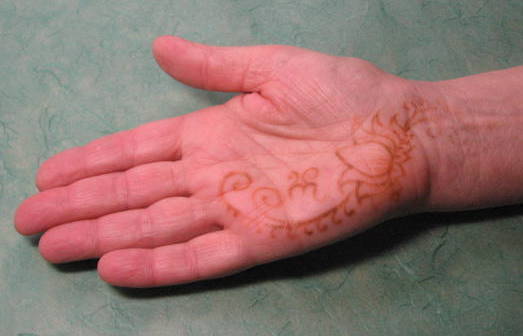
Ganesha sits on my left foot, grounding me as my feet touch the earth. On my right palm a lotus blossom and Om sign remind me that my hands are an important part of my yoga teaching as I encourage students’ bodies into alignment.

For a week I have been watching the henna designs blossom, and begin to fade. Beauty does not last forever, but the significance remains.

Henna, the artform known as Mehndi has been used as part of social celebrations possibly longer than yoga as been practiced. When a week ago Martine Boudreau had an Open House to celebrate five years of being in business, she invited Larissa Reinders of Dragonfly Designs to offer henna decorations.


Martine owns Carnelia Stones and Crystals on McLaughlin Drive in Moncton. We first met several years ago offering workshops during Wellness Weekends at the Algonquin in St, Andrews. Our paths keep crossing and she’s practiced yoga with me. I bought a piece of unpolished Lapis Lazuli for the shrine at The Yoga Space and a beautiful Snowflake Obsidian


Larissa, who lives in Fredericton, is one of only three internationally certified natural henna artists in Canada. We had discussed the symbols I wanted and she worked swiftly and smoothly, creating the designs freehand with amazing felicity.


Henna paste is made by drying, milling and sifting the leaves of the plant then mixing the powder with lemon juice, strong tea, or oils to create a paste that is used to crate fine design. The henna plant, part of the loosestrife family, also has medicinal properties, one being  the ability to cool down the human body.


Being hennaed is also about slowing down and being patient. The paste has to dry, helped by being sealed with a lemon/sugar solution. With three other women having the treatment I sat by Martine’s stove, chatting as the heat helped to dry the paste.


Ideally you leave the paste on for 12 or more hours; the longer the deeper and darker the design will be.


It was Sunday morning before I brushed the paste off my hand. Larissa had ‘bandaged’ my foot, so on one of the coldest days recently I could put on a sock.  When I removed the tape a reverse Ganesha was revealed. Not being impatient to see the results is part of the process.  The designs are reddish but quickly darken.


During the week I’ve been reflecting on the connection between yoga and this ancient art. Both encourage you to slow down, to reflect. I felt connected with the women who had received this age-old celebratory body decoration.  Henna is regarded as having ‘Barakah’, blessings, and is applied for luck as well as joy and beauty. It’s a frequent part of wedding ceremonies.

 This was how the henna on my hand looked a week later.


As the designs fade I’ll document the process.